

The Conversation More Couples Are Having
Open marriage is no longer a fringe topic whispered about in certain social circles. It has moved, quietly but unmistakably, into mainstream conversation — appearing in magazine features, podcast episodes, Netflix documentaries, and increasingly, in the consulting rooms of couples therapists across the United Kingdom.
And yet, for all its cultural visibility, open marriage remains profoundly misunderstood. It is romanticised by those who see it as a liberation from outdated convention, and demonised by those who regard it as a sophisticated rationalisation of infidelity. The clinical reality, as ever, is considerably more complex than either position allows.
This article does not advocate for open marriage. Nor does it condemn it. What it attempts to do — drawing on research, clinical experience, and the voices of real couples who have navigated this territory — is offer an honest, grounded account of what open marriage actually involves, what it can offer, and what it frequently costs. If you are considering it, already living it, or trying to make sense of a partner who has raised it, this is a space to think clearly.
Defining the Terms: What Open Marriage Actually Means
Before exploring the advantages and disadvantages, it is worth establishing what we mean by open marriage — because the term is used to describe a wide range of arrangements, and conflating them produces confusion.
An open marriage is a consensually non-monogamous relationship in which both partners explicitly agree that sexual or romantic involvement outside the marriage is permissible. The key word is consensual. This is what distinguishes open marriage from infidelity: not the presence of other partners, but the presence of mutual agreement and ongoing transparency.
Within this broad definition, there are significant variations. Some open marriages involve purely sexual connections outside the primary relationship, with romantic exclusivity firmly maintained. Others permit emotional entanglement as well — a model more commonly described as polyamory, though the boundaries between these terms are contested. Some couples establish highly specific rules: particular people are off limits, disclosures must be made within a certain timeframe, or other partners must never be brought into shared social spaces. Others prefer a more fluid arrangement with fewer formal structures.
Understanding which model is under discussion matters enormously — both for couples considering this path and for therapists supporting them.
The Pros: What Proponents and Researchers Actually Say
It would be intellectually dishonest to discuss open marriage without genuinely engaging with its potential benefits. Research in this area has grown considerably over the past decade, and the findings are more nuanced than popular culture tends to acknowledge.
Authenticity and the Reduction of Suppression
For individuals who experience attraction to multiple people — which, psychologists note, is a common human experience rather than an aberration — strict monogamy can involve a form of chronic suppression. When desire is forced underground rather than acknowledged openly, it can generate shame, resentment, and the kind of low-level disconnection that erodes intimacy over time.
Some couples report that transitioning to an open arrangement allowed them to bring their full selves to the marriage, including aspects of their sexuality or relational needs that had previously been hidden. This transparency, they argue, deepened rather than diminished their primary bond.
Longevity and Reduced Pressure
The expectation that one person must meet all of another person’s emotional, intellectual, sexual, and social needs is, when examined critically, an extraordinarily demanding one. Some research suggests that consensually non-monogamous couples report high levels of relationship satisfaction — not despite their arrangement but partly because of the reduction in pressure it creates.
When a partner’s social or sexual needs can occasionally be met elsewhere, the primary relationship is released from the obligation to be everything at once. For some couples, this produces a genuine sense of spaciousness within the marriage.
Sexual Revitalisation
Long-term relationships frequently encounter desire discrepancy and the dulling of erotic charge that researchers sometimes call habituation — the simple consequence of profound familiarity. Some couples report that the introduction of new sexual experiences, and the conversations those experiences generate between primary partners, rekindled desire that had significantly diminished.
The psychological mechanism here is sometimes described in terms of what the therapist and author Esther Perel calls the erotic imagination: desire requires some element of the unknown, and consensual non-monogamy can, for some couples, reintroduce that element without deception.
Honest Communication as a Foundation
Paradoxically, many open marriages require — and therefore develop — higher levels of communication than many conventional ones. Negotiating an open arrangement demands explicit conversations about boundaries, needs, jealousy, and values that many monogamous couples never have. Several couples in therapy report that the process of opening their marriage, whatever its outcome, produced a quality of conversation that they had never previously achieved.
The Cons: What the Therapy Room Reveals
If the benefits of open marriage are real, so are its costs — and in the clinical setting, those costs are frequently visible in ways that public discourse tends to understate.
Asymmetric Desire and Coercion
One of the most common presentations in couples therapy involving open marriage is asymmetric desire: one partner genuinely wants an open arrangement, and the other has agreed — out of fear of losing the relationship — without truly wanting it. This is not a consensual open marriage. It is, in psychological terms, a coerced one, and the consequences for the reluctant partner can be severe: escalating anxiety, a deepening sense of inadequacy, and a grief for the marriage they believed they had entered.
Therapists working in this area are trained to look carefully at the quality of consent. Agreement is not the same as genuine desire, and the difference matters profoundly.
Jealousy and Its Complications
Proponents of open marriage sometimes suggest that jealousy is a product of conditioned possessiveness that can be unlearned. There is some truth in this. But jealousy is also a deeply rooted attachment response — one that signals, at a neurobiological level, a perceived threat to a primary bond. For many people, this response does not diminish with exposure. It intensifies.
The management of jealousy in an open marriage requires considerable emotional resources, strong individual psychological foundations, and a primary relationship that is already functioning well. When these conditions are not in place — when a couple is already struggling, or when one partner’s attachment style is predominantly anxious — the introduction of external connections can accelerate rather than relieve the distress.
The Rules That Cannot Hold
Many couples enter open marriages with carefully constructed agreements: specific boundaries designed to protect the primary relationship. In clinical experience, these agreements frequently prove more fragile than anticipated.
Emotions do not reliably comply with negotiated terms. A partner who agreed that emotional connections outside the marriage were acceptable may find, confronted with the reality of their spouse’s deepening involvement with someone else, that they cannot tolerate what they theoretically endorsed. Conversely, one or both partners may find themselves developing feelings for an outside person that exceed the agreed parameters, creating a situation that is structurally indistinguishable from an affair — regardless of the original framework.
Disparate Experiences Outside the Marriage
Open marriages do not operate in a social vacuum, and the external landscape is not neutral. Research consistently shows that heterosexual women in open marriages encounter significantly more interest from potential partners than their male counterparts, whilst gay men in open relationships navigate different social and sexual dynamics again. When one partner finds the open arrangement enriching and the other finds it isolating or humiliating, the imbalance can become deeply corrosive to the primary relationship.
The Impact on Children and Family Systems
When children are present, the open marriage question acquires additional complexity. Children need relational stability and consistent attachment figures. The disruption — logistical, emotional, and sometimes residential — that open arrangements can introduce into family life is a consideration that requires serious and sustained attention.
Questions of disclosure are also non-trivial. At what age, if ever, should children be aware of a parent’s relationship structure? How are outside partners introduced? How are boundaries maintained when two worlds — the family world and the outside relationship world — begin to overlap?
What the Research Actually Says
The academic study of consensual non-monogamy is still a relatively young field, and its findings are complicated by significant methodological challenges: self-selecting samples, social desirability bias, and the difficulty of longitudinal research on relationship structures that may shift considerably over time.
What the existing evidence suggests is roughly as follows: consensually non-monogamous couples report relationship satisfaction broadly comparable to monogamous couples, with some measures of trust and communication appearing higher in CNM samples. However, they also report higher rates of certain specific challenges, including jealousy management difficulties and the negotiation of boundaries.
Critically, the research does not support the conclusion that open marriage is either inherently superior or inherently inferior to monogamy. What it supports, rather, is the conclusion that relationship structure matters far less than the quality of communication, the degree of genuine mutuality, and the strength of the underlying attachment between primary partners.
When to Seek Couples Therapy
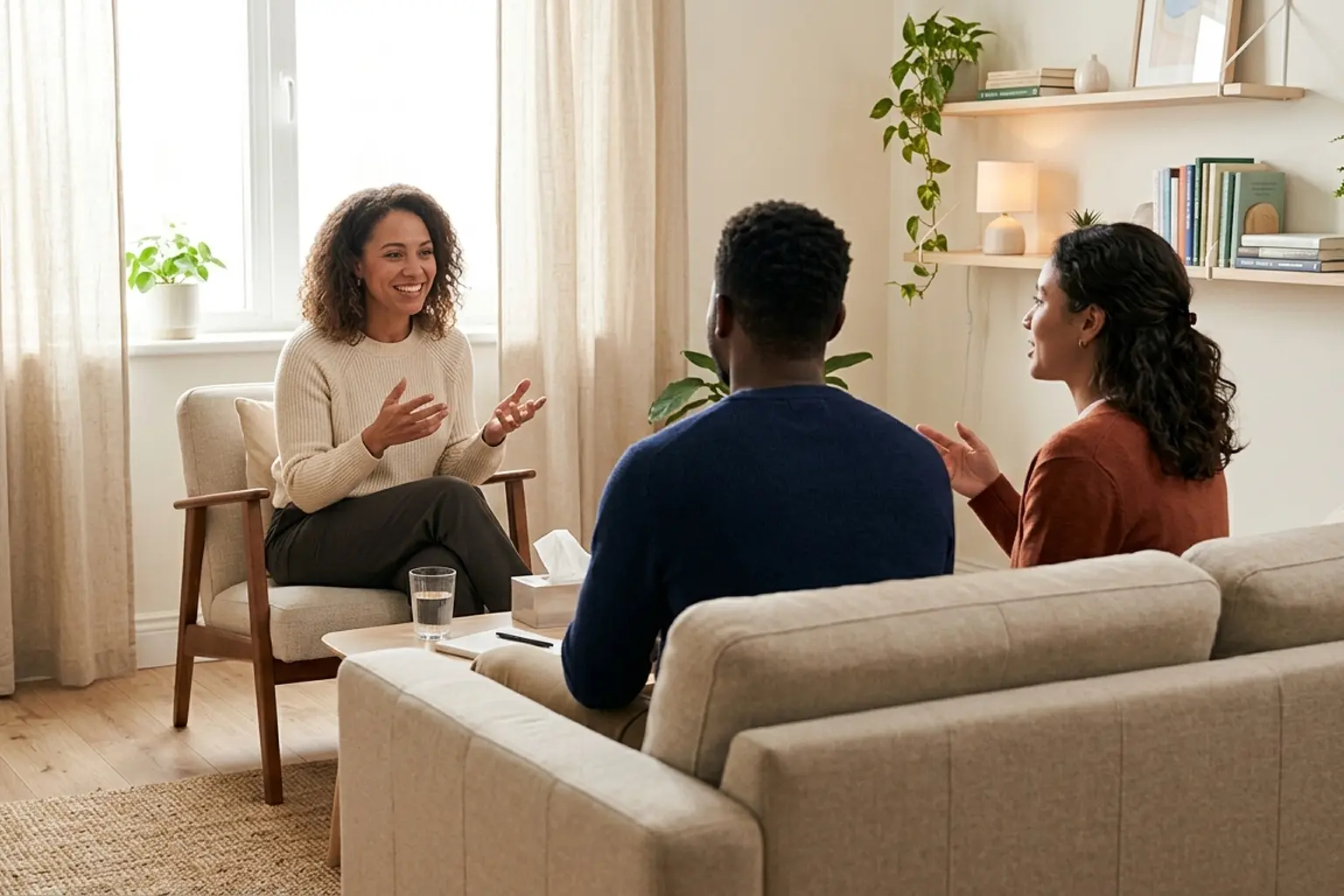
If you are considering an open marriage, already in one, or navigating the aftermath of one that did not unfold as anticipated, couples therapy can offer meaningful support at every stage.
A skilled therapist working in this area will not impose a value judgement about relationship structure. What they will do is help both partners examine their genuine motivations, identify the emotional dynamics that are shaping the conversation, and develop the communication tools that any significant relational renegotiation demands.
Particular moments when professional support is valuable include: when one partner has proposed opening the marriage and the other is uncertain; when an agreed arrangement has begun to feel unworkable for one or both partners; when jealousy or emotional entanglement with an outside partner has become destabilising; and when the couple is considering closing an open arrangement and rebuilding their primary bond.
A Final Word
Open marriage is neither a progressive utopia nor a slow-motion catastrophe. It is a relational choice — one with genuine potential benefits and genuine potential costs, both of which are shaped enormously by the specific people involved, the quality of their communication, and the solidity of the foundation upon which any renegotiation is built.
What it is not is a solution to a troubled marriage. Research and clinical experience align on this point with some consistency: opening a relationship that is already struggling rarely repairs what is broken. It more commonly accelerates the fracture.
If you are exploring questions about the structure of your relationship and would like to speak with one of our specialist couples therapists at London Trusted Therapy, we welcome you to reach out. These are some of the most important conversations a couple can have — and they deserve to happen in a space that is thoughtful, confidential, and genuinely without judgement.
