

When the Ground Shifts Beneath Everything You Thought You Knew
There are moments in a marriage that divide life into before and after. A husband’s disclosure that he is gay — or bisexual, or questioning — is one of the most seismic of those moments. It does not arrive with a manual. It does not come with clear instructions about what to feel, what to say, or what happens next.
If you are reading this in the hours or days after such a conversation, the first thing to understand is this: what you are experiencing is a legitimate crisis. Not a dramatic overreaction. Not something you should be able to simply process and move on from. A crisis — in the truest clinical sense — of identity, trust, grief, and profound disorientation.
This article is written for both partners in what is known as a mixed-orientation marriage: the spouse who has received this disclosure, and the husband who has made it. Both of you are standing on unfamiliar ground. Both of you deserve clarity, compassion, and — when you are ready — skilled support.
What Is a Mixed-Orientation Marriage?
A mixed-orientation marriage (sometimes called a MOM) is a marriage in which one partner identifies as heterosexual and the other identifies as gay, lesbian, bisexual, or queer. These marriages are far more common than public discourse acknowledges.
Research suggests that in the United States alone, between one and two million gay or bisexual men are — or have been — married to women. UK figures are harder to establish, in part because many such marriages remain private, but clinical practitioners across the country will confirm that this is not a rare presentation. It arrives in therapy rooms with considerable regularity, and it arrives carrying enormous emotional weight.
Mixed-orientation marriages do not arise from deception alone. Many men who come out later in life genuinely did not fully understand their own sexuality when they married. Others were aware of same-sex attraction but believed — whether through religious conviction, cultural pressure, internalised shame, or genuine love for their partner — that marriage was the right path. Some have lived entire decades carrying a truth they could not yet name.
This context does not erase the impact on the spouse who did not know. But it is essential context, because it shapes how both partners can begin to make sense of what has happened.
The Emotional Experience of the Straight Spouse
The straight spouse — most commonly, though not exclusively, a woman — faces a layered and often contradictory grief. Therapists working in this area observe a pattern that is distinct from other forms of relationship rupture, and it is worth naming that pattern clearly.
Shock and Disbelief
Shock and disbelief are almost universal immediate responses. Even in cases where there were signs — emotional distance, a lack of sexual initiative, unexplained absences — the conscious mind rarely prepares itself for this particular truth. The revelation can feel surreal, as though the marriage itself has become suddenly unrecognisable.
Retroactive Questioning
Retroactive questioning follows quickly. Was any of it real? Did he ever love me? Were those years a lie? This is one of the most painful cognitive loops a straight spouse can enter, and it can be profoundly destabilising to one’s sense of reality. It is important to understand that these questions, whilst completely understandable, do not always have clean answers — and that the absence of clean answers does not mean the marriage was fraudulent.
Grief
Grief comes in multiple waves and forms. There is grief for the marriage as it was understood. Grief for the future that was imagined. Grief for the sexual and romantic self — because many straight spouses find themselves questioning their own attractiveness, their femininity or masculinity, their adequacy as a partner. The thought ‘Was I not enough?’ is almost inevitable, even though it fundamentally misunderstands the nature of sexual orientation.
Anger
Anger is healthy and appropriate, and it must be allowed space. This is a loss that was not chosen. Anger at the secrecy, at the years of misdirection, at the disruption to one’s entire life narrative — all of this is a legitimate part of the grief process.
Isolation
Isolation is a significant risk. Many straight spouses feel they cannot speak openly about what has happened, whether out of loyalty to their husband, shame, or fear of social judgement. The result is a grief that is carried largely alone, which is why specialist support — including peer support groups for straight spouses — can be genuinely transformative.
The Emotional Experience of the Gay Husband
It would be a profound clinical and human error to understand this situation only through the lens of the straight spouse’s pain — significant though that pain is. The husband who has come out is also in crisis, often one that has been building for a very long time.
For many gay men who marry heterosexually, the years before disclosure are characterised by a form of chronic psychological strain: the effort of suppression, the vigilance required to maintain a public identity that does not fully reflect one’s inner reality, and — often — a deep and genuine love for a partner that coexists uncomfortably with an awareness of something unresolved. This is not a comfortable position. It is exhausting, isolating, and frequently accompanied by anxiety, depression, and a fractured sense of self.
Coming out within a marriage carries its own particular terror. The potential losses are enormous: the marriage itself, the family structure, relationships with children, community ties, professional reputation in some contexts, and the love of someone who is also being hurt by the disclosure. Many gay husbands live for years in a paralysis between authenticity and the fear of devastation.
This does not mean the straight spouse must contain their own pain in order to accommodate the husband’s. Both experiences are real. Both deserve space. What it does mean is that couples therapy — when both partners choose it — works best when it holds the complexity of both positions simultaneously, without assigning villainhood to either.
Can the Marriage Survive? The Question Everyone Asks
The answer is: sometimes, and it depends what survival means to both of you.
Some mixed-orientation marriages do continue, and continue in forms that are honest, consensual, and workable for both partners. This might involve a renegotiated relationship structure — one that acknowledges the husband’s orientation and creates space for both partners’ needs. It might involve a celibate companionate partnership where emotional intimacy remains the primary bond. These arrangements are not common, and they require extraordinary levels of communication, trust-rebuilding, and individual psychological work. But they exist, and they can be meaningful.
For most couples, however, disclosure marks the beginning of the end of the marriage as it existed — even if the process of ending is slow, mutual, and conducted with care. This is not failure. It is honesty, arriving — however painfully — in the service of both people’s lives.
What matters most in the immediate aftermath is not reaching a decision about the future of the marriage. What matters is stabilisation: both partners finding enough psychological ground beneath their feet to think clearly, to feel safely, and to make choices that reflect their genuine needs rather than panic or pressure.
The Role of Children and Family Systems
When children are involved, the complexity deepens considerably. Children are perceptive, and they will sense that something significant has changed in the family atmosphere, even if they do not know what it is. The question of what to tell them — and when, and how — is one that requires careful thought and, ideally, professional guidance.
Research on children of gay parents, and on children who learn about a parent’s sexual orientation during childhood or adolescence, suggests that outcomes are largely shaped not by the disclosure itself but by the quality of co-parenting that follows it. Children fare best when both parents maintain their own emotional regulation, avoid using the children as confidants or messengers, and demonstrate — even through difficulty — that both adults remain committed to the children’s wellbeing.
This is easier to say than to do. It is very difficult to co-parent generously from inside one’s own grief. This is one of the strongest arguments for engaging therapeutic support not only for the couple, but for the individual parents and — when appropriate — for the children themselves.
What Couples Therapy Offers in This Context
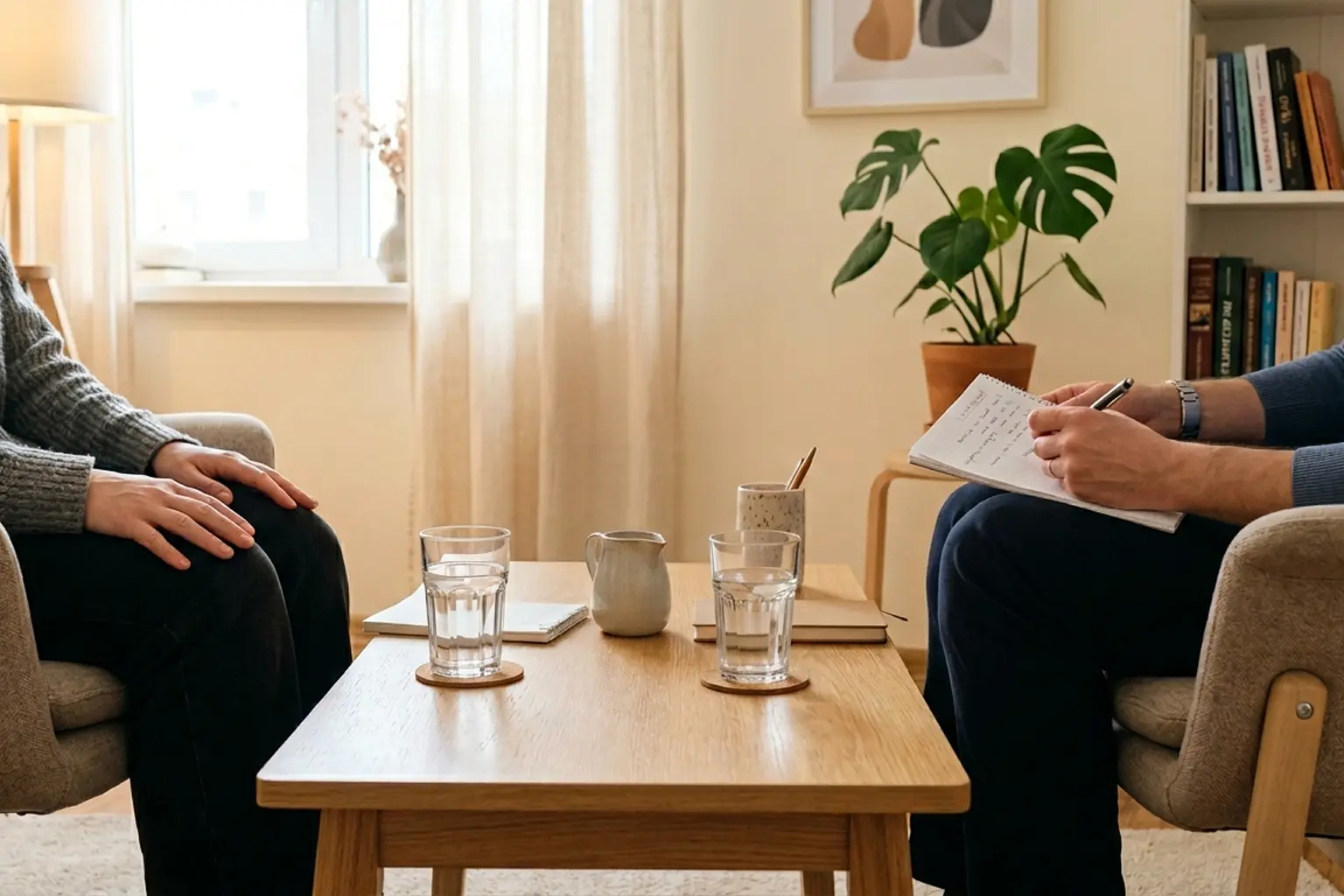
Couples therapy in the context of a mixed-orientation marriage does not exist to save the marriage at all costs. A skilled therapist working in this area holds a very different goal: to create a contained, boundaried space in which both partners can speak honestly, be heard genuinely, and begin to understand what each of them needs in order to move forward — whether together or apart.
Specific areas where couples therapy provides meaningful support include:
Processing the Disclosure Itself
Many couples have a single conversation — often chaotic, emotionally overwhelming, and inadequately contained — and then find themselves unable to return to the subject with any degree of coherence. A therapeutic space allows the conversation to happen properly, with both partners present and a skilled witness holding the process.
Rebuilding a Narrative
One of the most disorienting aspects of this experience is the sense that the past has been retroactively altered. Therapy can help both partners construct a more accurate and more compassionate account of what the marriage actually was — one that neither erases the genuine connection nor minimises the impact of what was withheld.
Making Decisions Under Conditions of Distress
Legal, financial, residential, and parenting decisions must ultimately be made. Therapy cannot make these decisions, but it can support both partners in approaching them from a more grounded and less reactive position.
Maintaining a Workable Relationship Post-Marriage
For couples with children, the end of the marriage is not the end of the relationship. Therapy can help establish the terms of a co-parenting partnership that serves the children’s needs, even as the romantic partnership concludes.
Finding Your Way Through: Practical First Steps
If you are in the immediate aftermath of this disclosure, the following may offer some initial orientation:
Allow yourself to feel what you feel, without censoring it. Shock, grief, anger, confusion, even moments of strange calm — all of these are valid. There is no correct emotional response to this.
Resist the pressure to make decisions immediately. Neither partner should feel compelled to announce a course of action within days or even weeks of a disclosure of this magnitude. The decisions will come. They do not need to come yet.
Seek individual support as a priority. Whether through a therapist, a trusted friend, or a peer support group specifically for straight spouses, finding someone who can hold your experience without judgement is essential.
Consider couples therapy, even if the marriage is ending. The process of separating with care, particularly where children are involved, is one that benefits profoundly from professional support.
Be cautious about who you tell, and when. The impulse to reach out widely is understandable, but disclosures made in acute distress can have consequences that are difficult to manage later.
A Final Word
A husband’s disclosure that he is gay changes everything. It also changes nothing about who either of you fundamentally are as human beings. You are both, in different ways, confronting a truth that has long been present — and now, at last, cannot be avoided.
That confrontation is painful. It is also, in the hands of skilled support, the beginning of the possibility of something more honest for both of you. Whatever the future of the marriage, the future of each individual life can be one that is lived with greater authenticity, greater self-knowledge, and — in time — greater peace.
If you are navigating this experience and would like to speak with one of our therapists at London Trusted Therapy, we offer specialist couples therapy and individual support in a confidential, non-judgmental environment. You do not have to find your way through this alone.
