

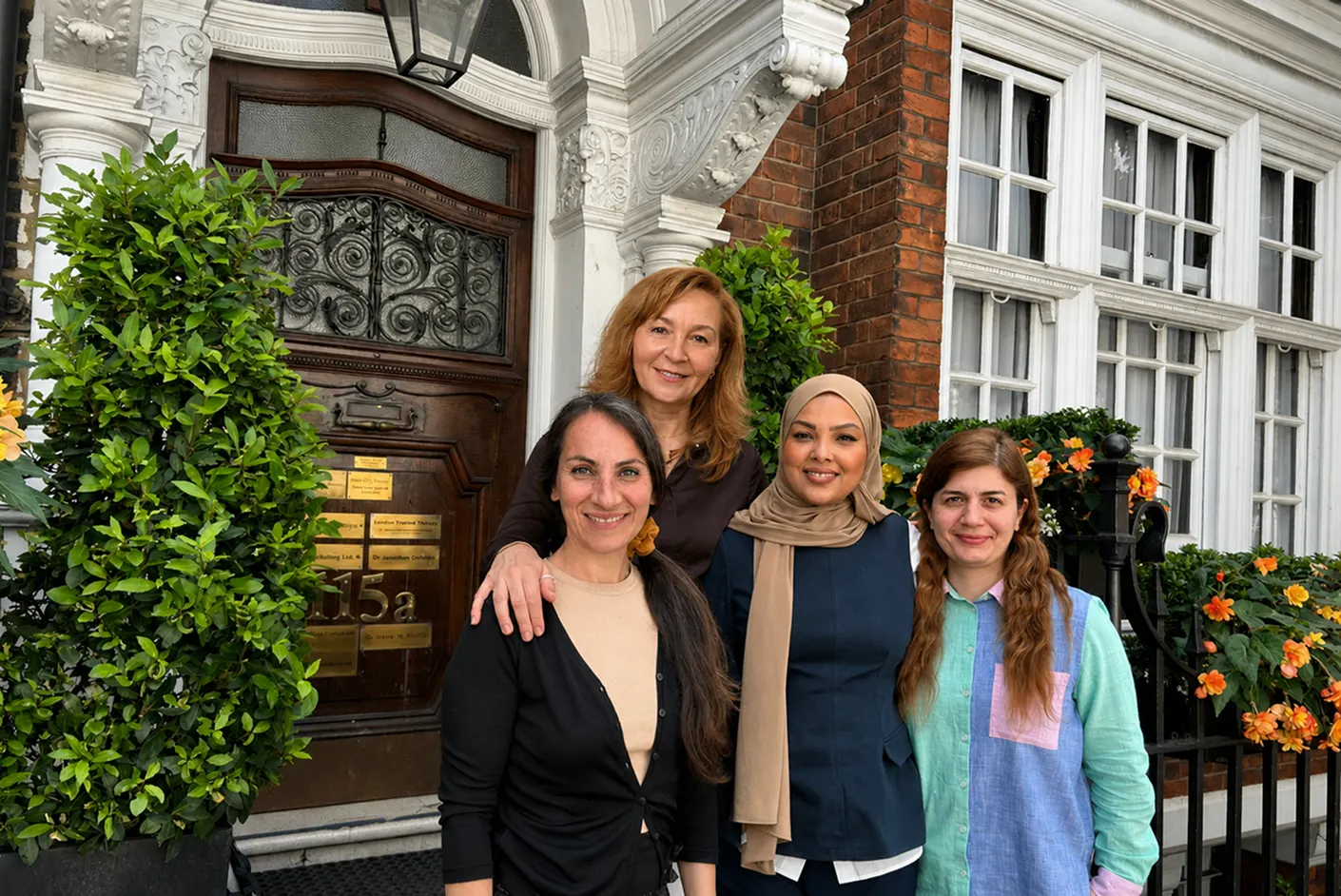
On 18 July, the multi-disciplinary team at London Trusted Therapy (LTT) gathered at our flagship Pinero House premises on Harley Street for a specialist presentation on Augmentative and Alternative Communication (AAC), delivered by Riffat Hussein, our Specialist Speech and Language Therapist. The session formed part of LTT’s ongoing commitment to continuing professional development across disciplines, and offered the wider team — psychologists, psychotherapists, occupational therapists and clinical support staff alike — a rich, practice-based introduction to the tools and frameworks that help non-verbal and minimally verbal clients find their voice.
Why AAC, and why now
Augmentative and Alternative Communication covers the full spectrum of methods, low-tech through to high-tech, that support individuals who experience difficulty with spoken language. For a multi-disciplinary team such as LTT’s, where clients often present with overlapping needs across speech and language, sensory processing, emotional regulation and psychological wellbeing, a shared understanding of AAC is invaluable. It ensures that whichever practitioner a client sees first, the whole team is equipped to recognise communication barriers early and to support consistent, joined-up strategies across every stage of a client’s care.
Riffat’s session was designed with exactly that shared understanding in mind: practical, accessible, and directly relevant to the day-to-day work of colleagues who may not specialise in speech and language therapy themselves, but who will regularly encounter clients for whom communication is a central part of the presenting picture.
From low-tech foundations to high-tech solutions
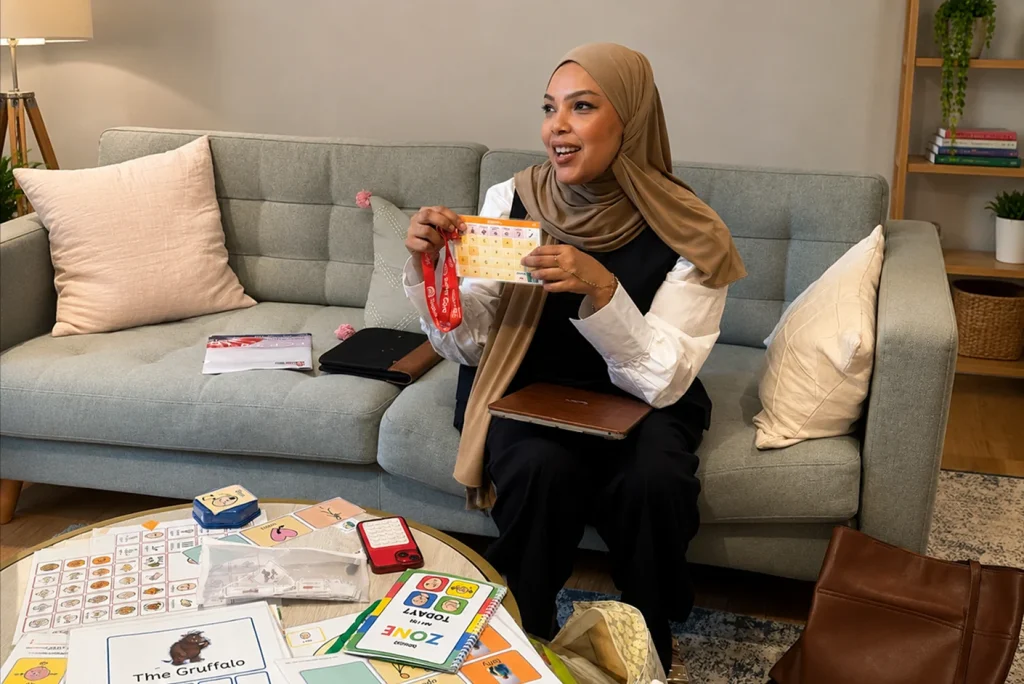
Riffat took the team on a guided journey across the AAC continuum, beginning with low-tech approaches such as Picture Exchange Communication System (PECS) and Widgit symbol systems, before moving through to sophisticated high-tech solutions including Proloquo2Go and The Grid. She explained how the choice of system is never one-size-fits-all: it depends on a careful, individualised assessment of a client’s cognitive profile, motor skills, sensory preferences and communicative intent.
Colleagues heard how low-tech tools remain a cornerstone of good practice, often forming the first stepping stone towards more complex systems, or serving as a reliable back-up when technology is unavailable or overwhelming for a client. High-tech AAC, by contrast, can open up extraordinary possibilities for clients with complex needs, offering a genuine independent voice, but only when introduced with the right scaffolding and family involvement around it.
Underpinning the presentation was Riffat’s grounding in a number of established clinical frameworks, including the SCERTS Framework (in which she was directly trained by its co-developer, Emily Rubin), Intensive Interaction, Colourful Semantics, and Blank’s Levels of Questioning. She wove these frameworks together to show the team how AAC is never introduced in isolation, but always within a wider developmental and relational approach to communication, one that considers a client’s social communication, emotional regulation and transactional support needs as a whole.
A specialist grounded in real-world practice
What gave the session its particular resonance was the breadth of first-hand experience Riffat brought to the room. She holds an MSc in Speech and Language Therapy (2021) and has built a career deeply rooted in supporting children and young people with complex autism spectrum needs. As Lead Speech and Language Therapist for the Resource Base and Inclusion provision at Tollgate Primary School, she supported 32 children, 16 of whom presented with complex autism, work that contributed to the setting achieving an Outstanding Ofsted rating in December 2022 and Advanced Accreditation from the National Autistic Society in 2023, following an intensive three-day inspection covering individual and group practice, SEND provision, resources, strategies and parent testimonials.
Riffat is also an experienced and much sought-after trainer in her own right. Over recent years she has delivered training to audiences ranging from 18 to over 200 participants, including SENCos, governors, speech and language therapists, occupational therapists, music therapists, teachers, senior leadership teams and teaching assistants, across organisations including the Boleyn Trust, Whittington Health Trust, London Speech Therapy, and the Send and Sensory Clinic.
Her training portfolio spans an impressive range of specialist areas: SCERTS training for the Boleyn Trust and London Speech Therapy; Lego Therapy across multiple trusts from 2022 to 2026; Attention Autism training delivered whole-trust across five schools; sessions on autism-specific approaches for neurodivergent learners; low-tech AAC using Widgit systems; Blank’s Levels of Questioning; high-tech Proloquo2Go training; PECS training delivered via London Speech Therapy across several cohorts; and, most recently, training on The Grid high-tech AAC system for two Whittington Health schools in 2026. She has also delivered training on the effective use of learning spaces, supporting learners with complex needs, and sensory stories, alongside parent-facing sessions on both PECS and high-tech AAC at SEND coffee mornings.
This combination of clinical grounding, accreditation-level scrutiny of her own practice, and years spent training other professionals meant that Tuesday’s session was delivered with genuine authority, drawing on real case examples and lessons learned from the classroom as much as from the clinic.
What the team took away
Feedback from colleagues who attended the presentation reflected just how valuable a shared, cross-disciplinary language around AAC can be. For our psychotherapists and psychologists, the session offered a clearer sense of when and how to flag communication concerns for specialist speech and language input. For occupational therapists, it highlighted the natural overlap between sensory regulation and communicative readiness, reinforcing how AAC strategies often work best when paired with sensory-informed environments. And for the wider clinical support team, it provided practical, transferable strategies, from the visual scaffolding embedded in Widgit systems to the structured questioning approach of Blank’s Levels, that can be applied across a range of client presentations, not only within formal speech and language sessions.
This kind of cross-pollination between disciplines lies at the heart of what makes LTT’s multi-disciplinary model distinctive. Rather than working in silos, our team is actively encouraged to learn from one another’s specialisms, ensuring that every client benefits from a genuinely joined-up, whole-person approach to their care.
Continuing a culture of learning
Tuesday’s presentation is part of a wider, ongoing programme of internal CPD at LTT, reflecting our founding commitment to clinical excellence and evidence-based, collaborative practice. As a multi-disciplinary Harley Street practice, we believe that our clinicians’ continued professional growth is inseparable from the quality of care our clients receive, and sessions such as this one exemplify exactly that principle in action.
We are enormously grateful to Riffat for so generously sharing her expertise, experience and evident passion for helping non-verbal and minimally verbal individuals find meaningful ways to communicate. Her session was a wonderful reminder of the difference that specialist, relationship-focused communication support can make, not only to the individuals directly supported, but to the families and professionals working alongside them.
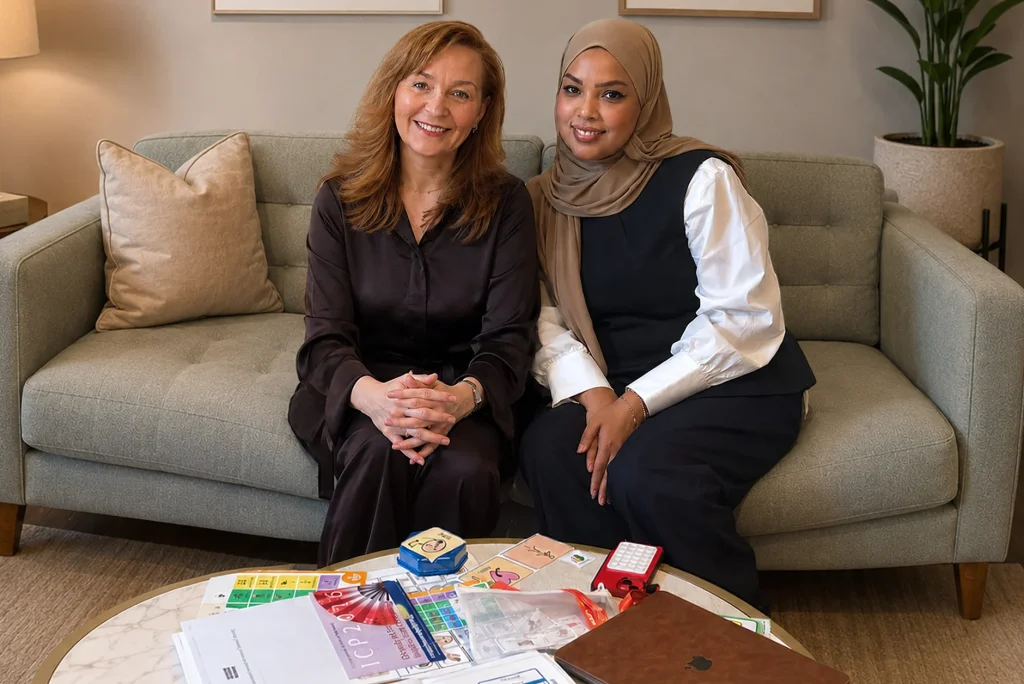
London Trusted Therapy will continue to share updates from our internal training programme, alongside insights from our clinicians, as part of our commitment to transparency, learning and excellence in mental health and communication support. To find out more about our multi-disciplinary team and the services we offer across our Harley Street, Welbeck Street and Chancery Lane locations.
